Launch offer — valid today only

📄 Digital book in PDF · read it on your phone or print it

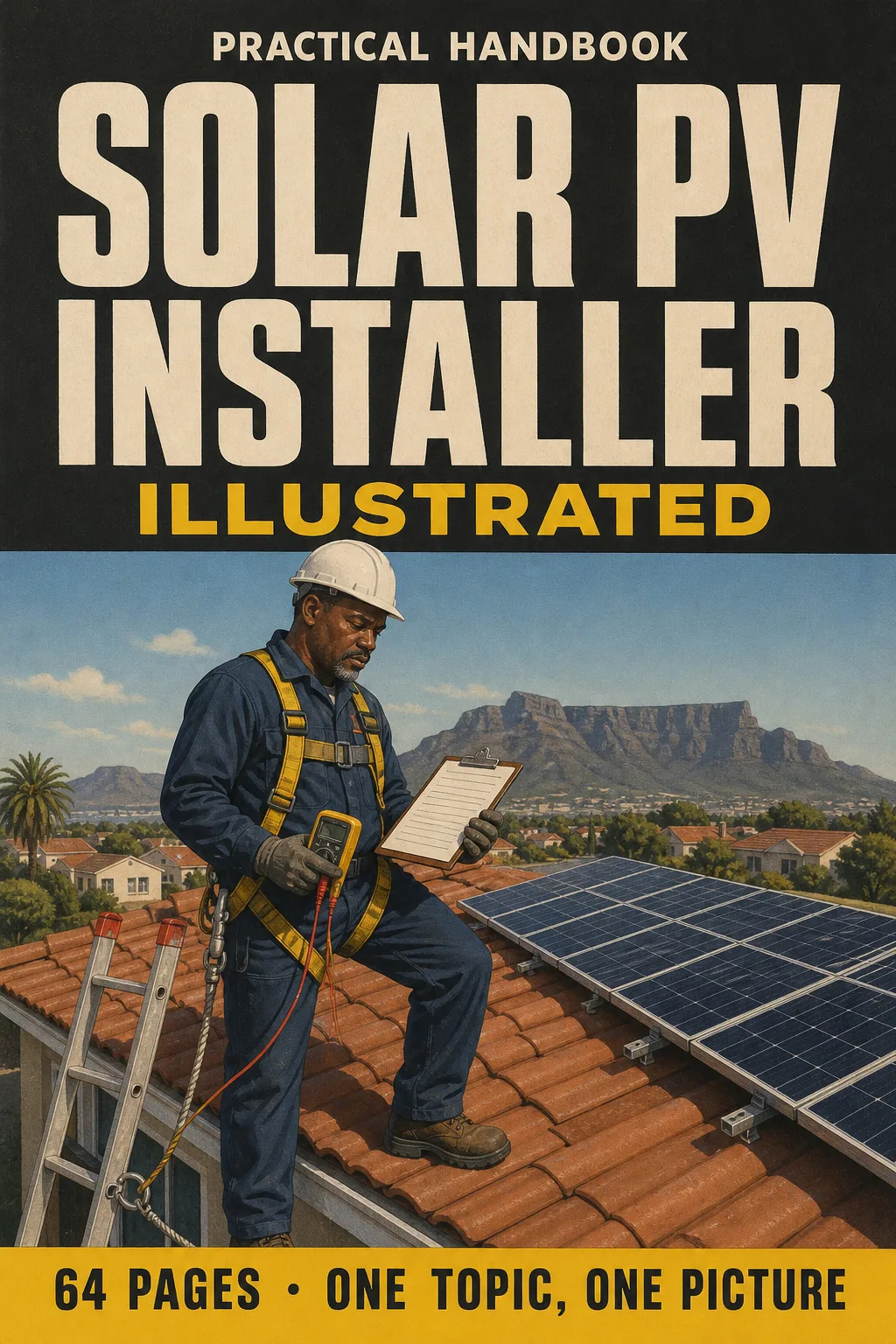
Solar PV Installation in Drawings: Size, Wire and Test Every System in the Same Order One Install Step on Every Page

Site survey, load lists, string design, cold-morning Voc, lithium batteries, DC cabling, isolators, earthing and commissioning. Every topic has its own page: the drawing first, then what you need to remember. 64 illustrated pages.

I WANT THE ILLUSTRATED BOOK

🔒 Secure checkout · PDF by email · 30-day guarantee

Every topic, its own pageEach calculation and install step drawn, with the explanation beside it
64 illustrated pages9 parts, from the whole system in one drawing to the formula sheet
Up-to-date sourcesSANS 10142-1, SANS 10142-1-2 and NRS 097-2-1
PDF by emailFormat

Look Inside the Book

Every page has one large drawing and a box with the numbers and steps you need to know:

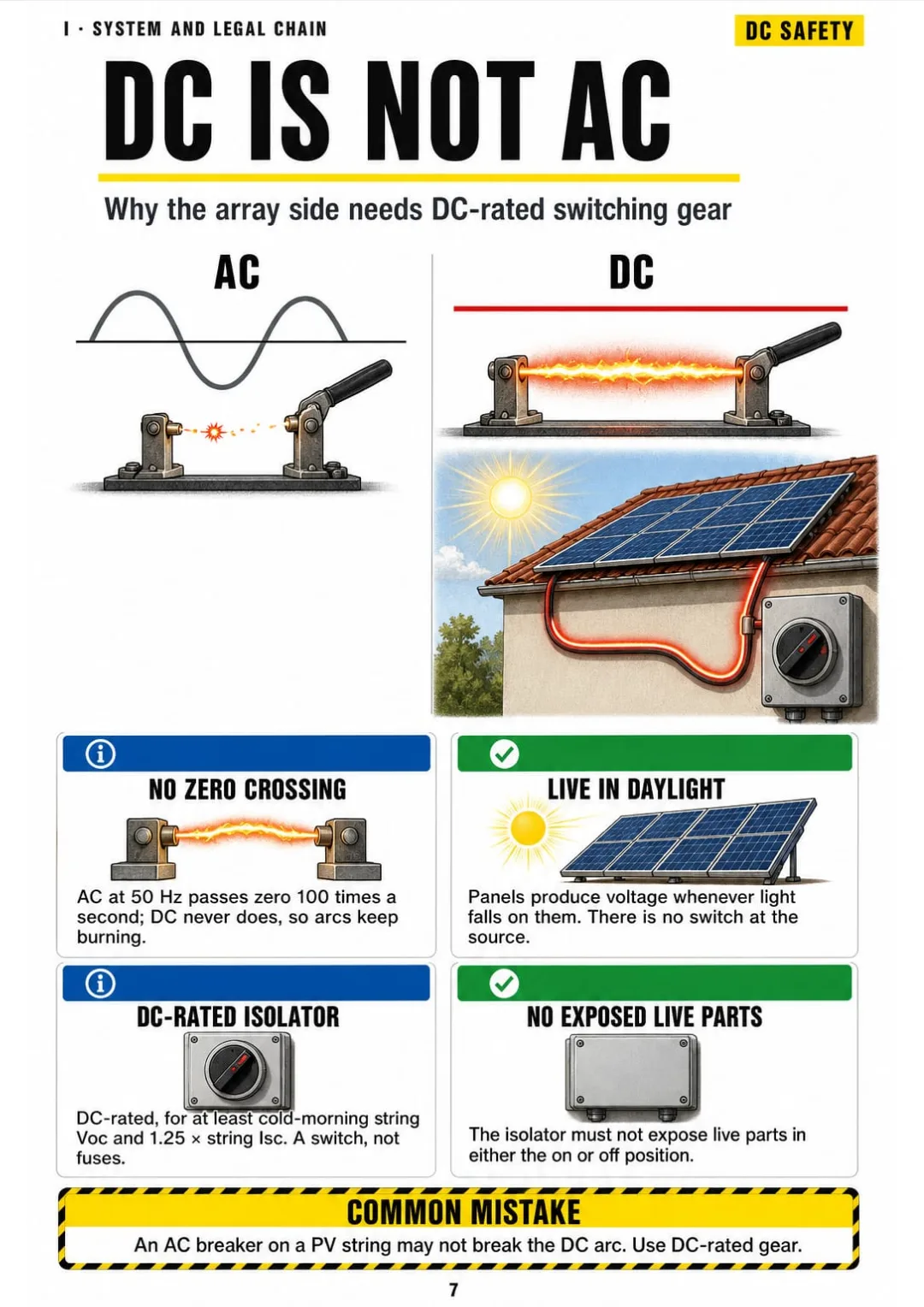
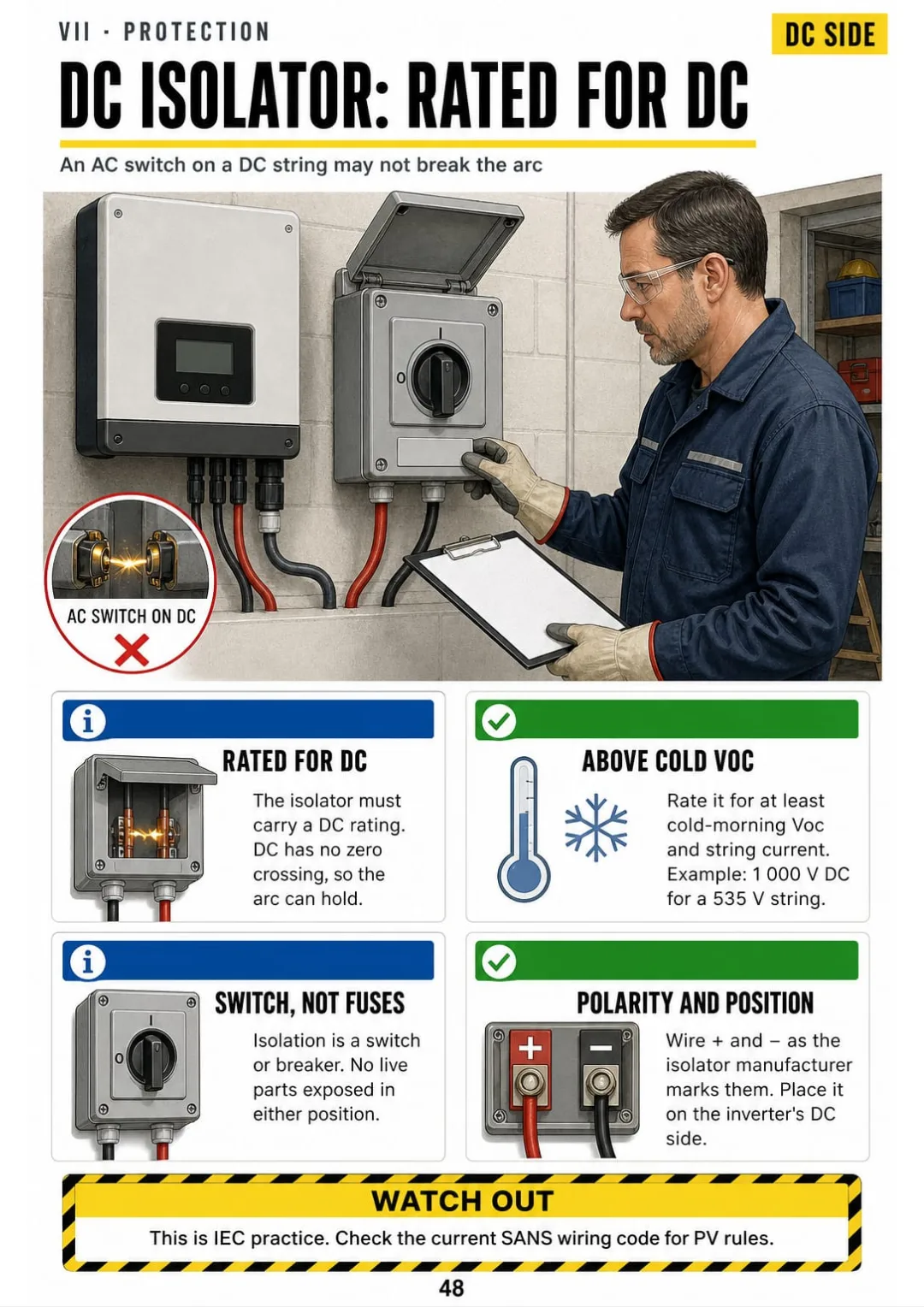
DC has no zero crossing: arcs persist, so isolators must be DC-rated for cold Voc
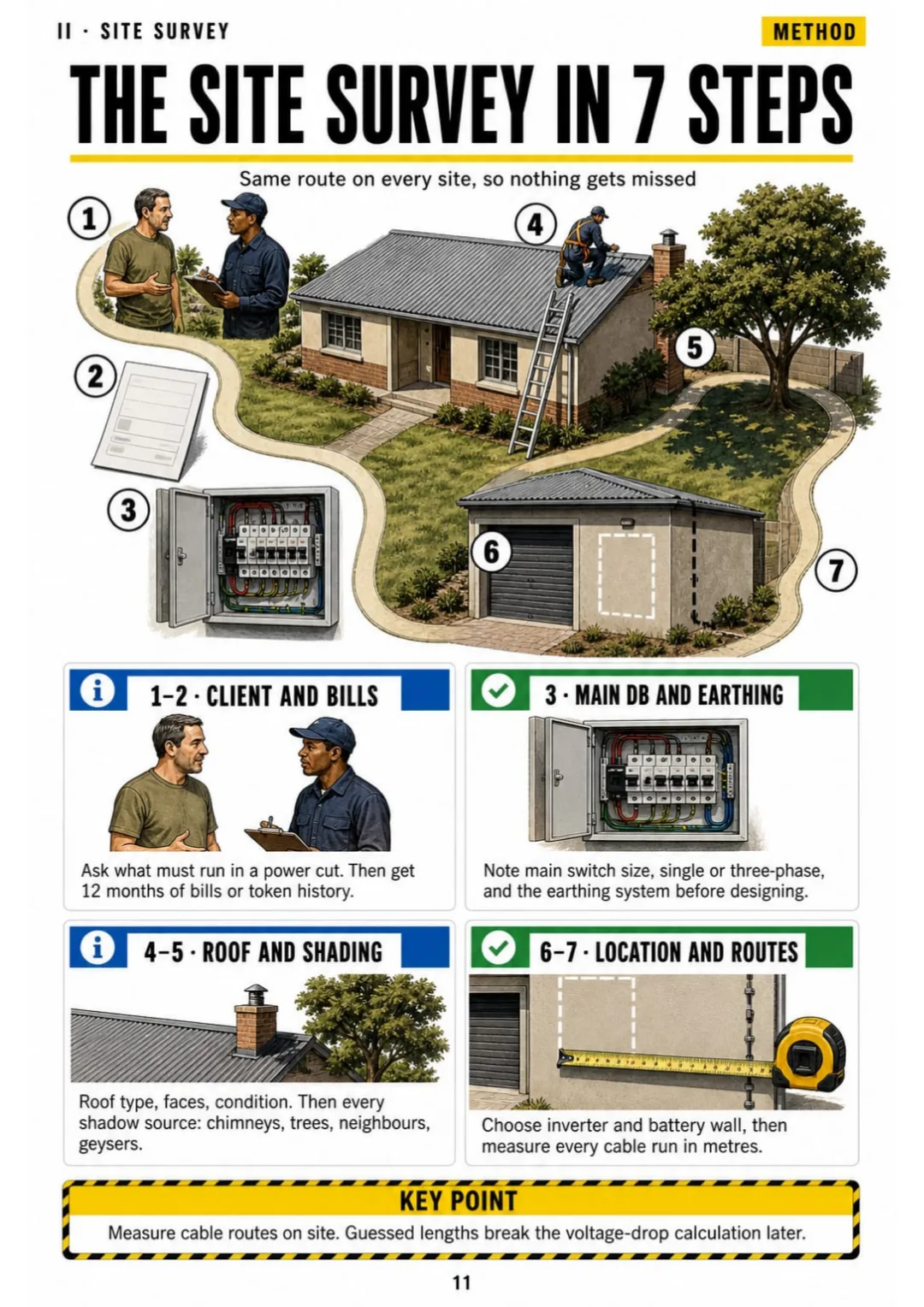
7 steps, always in order: client, bills, DB, roof, shading, location, cable routes
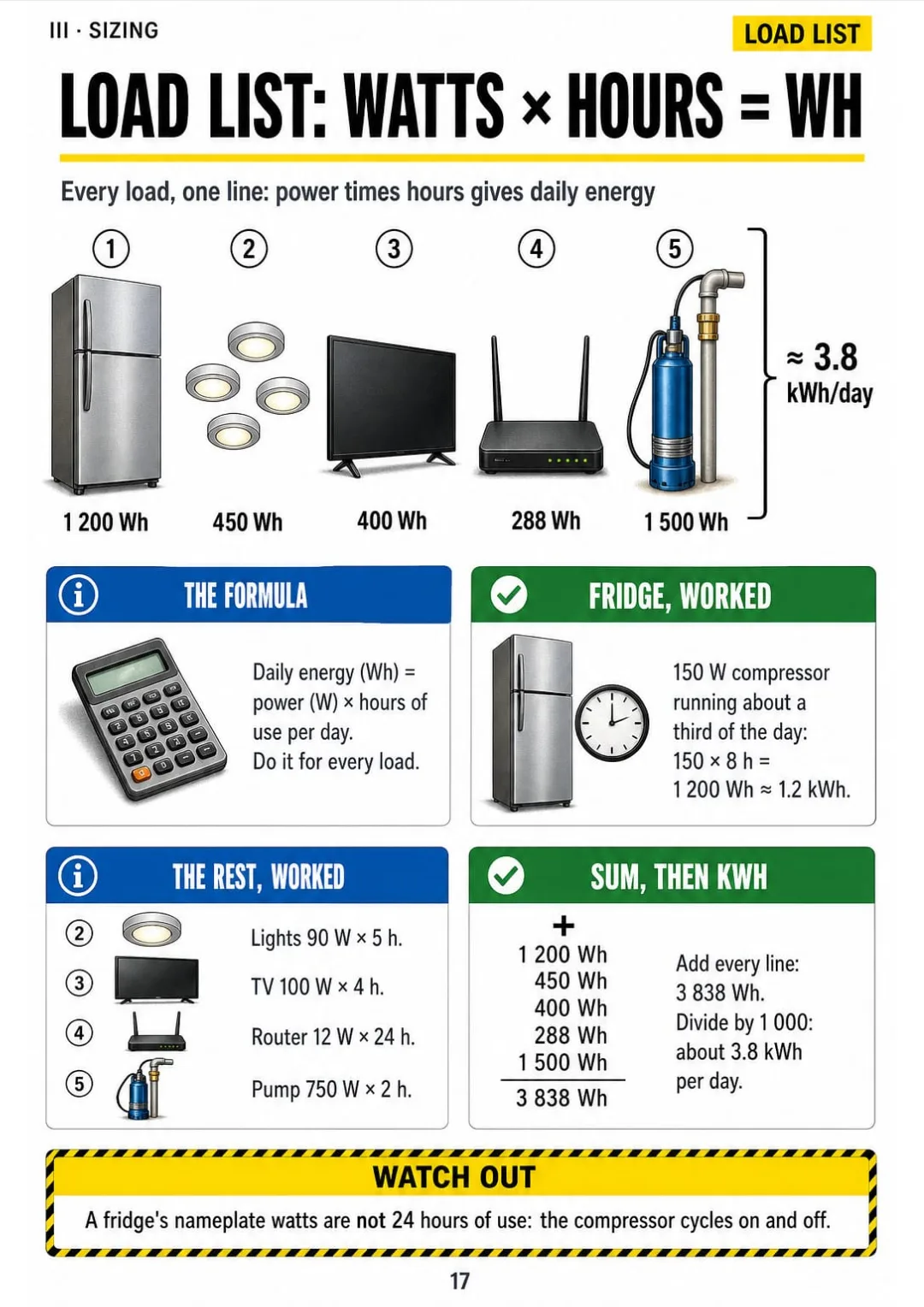
Fridge 150 W × 8 h = 1.2 kWh: the whole load list worked line by line.
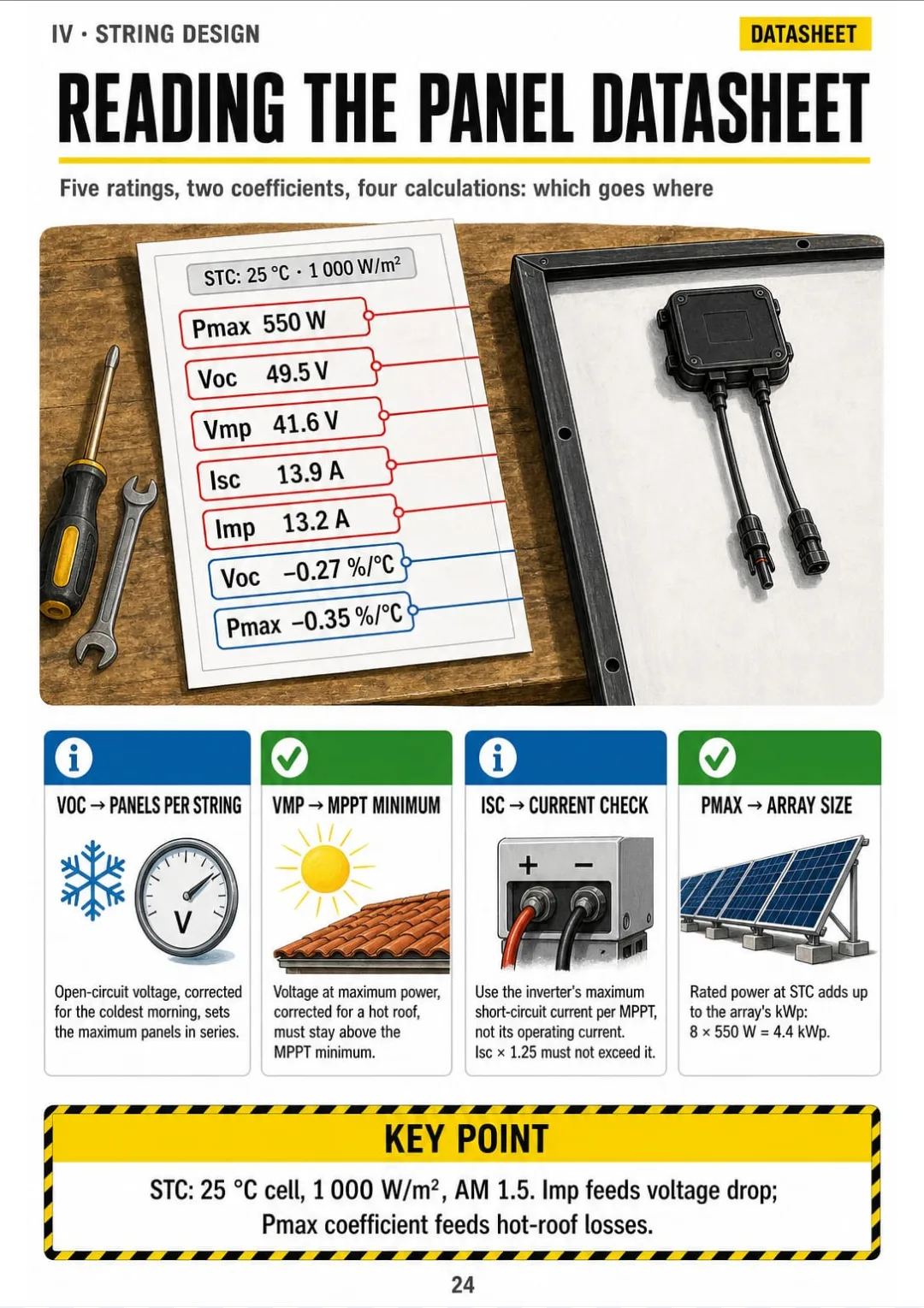
Voc, Vmp, Isc, Pmax and the coefficients: which number for which calculation
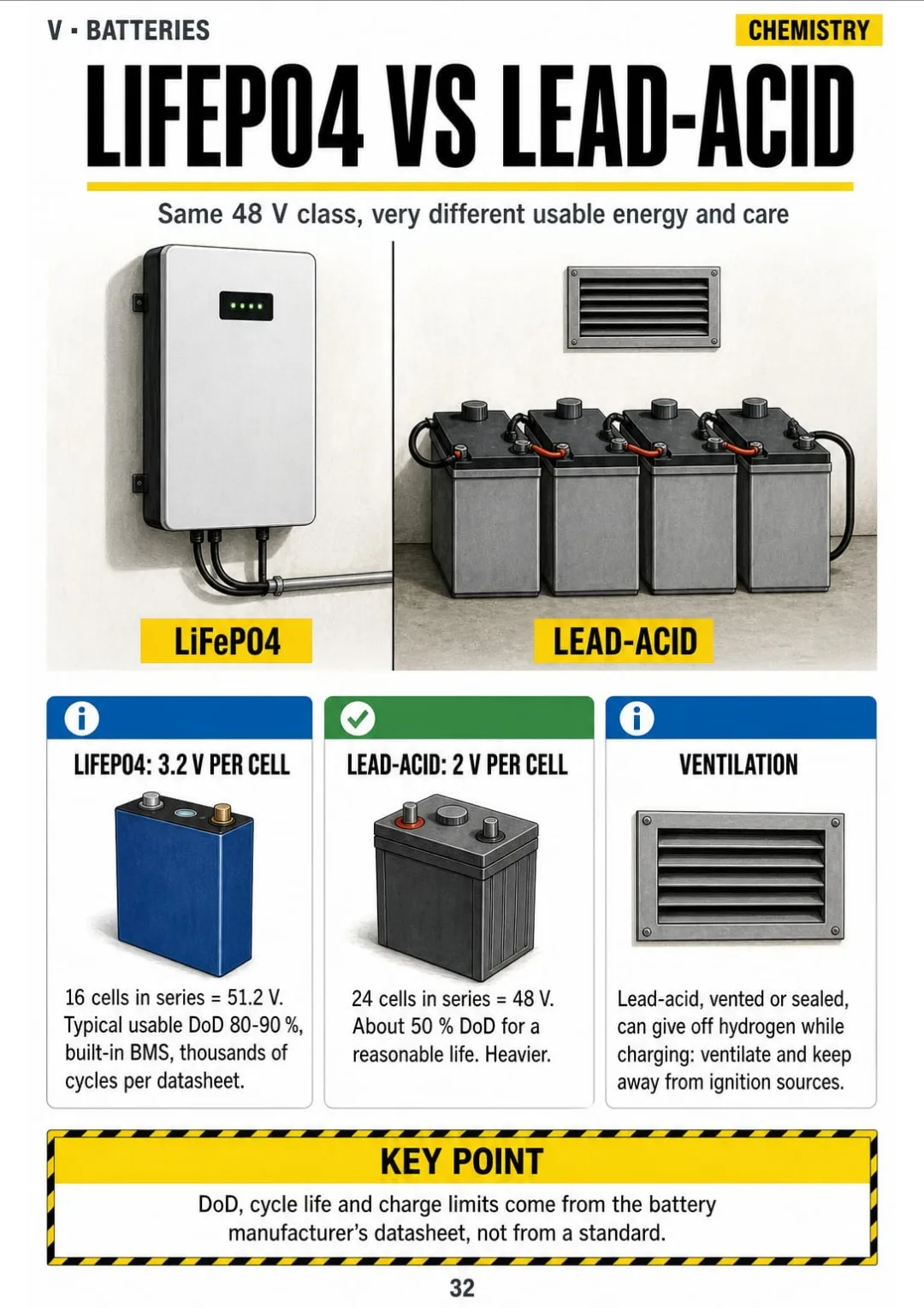
LiFePO4: 16 × 3.2 V = 51.2 V, 80-90 % usable · Lead-acid: 24 × 2 V = 48 V, about 50 %
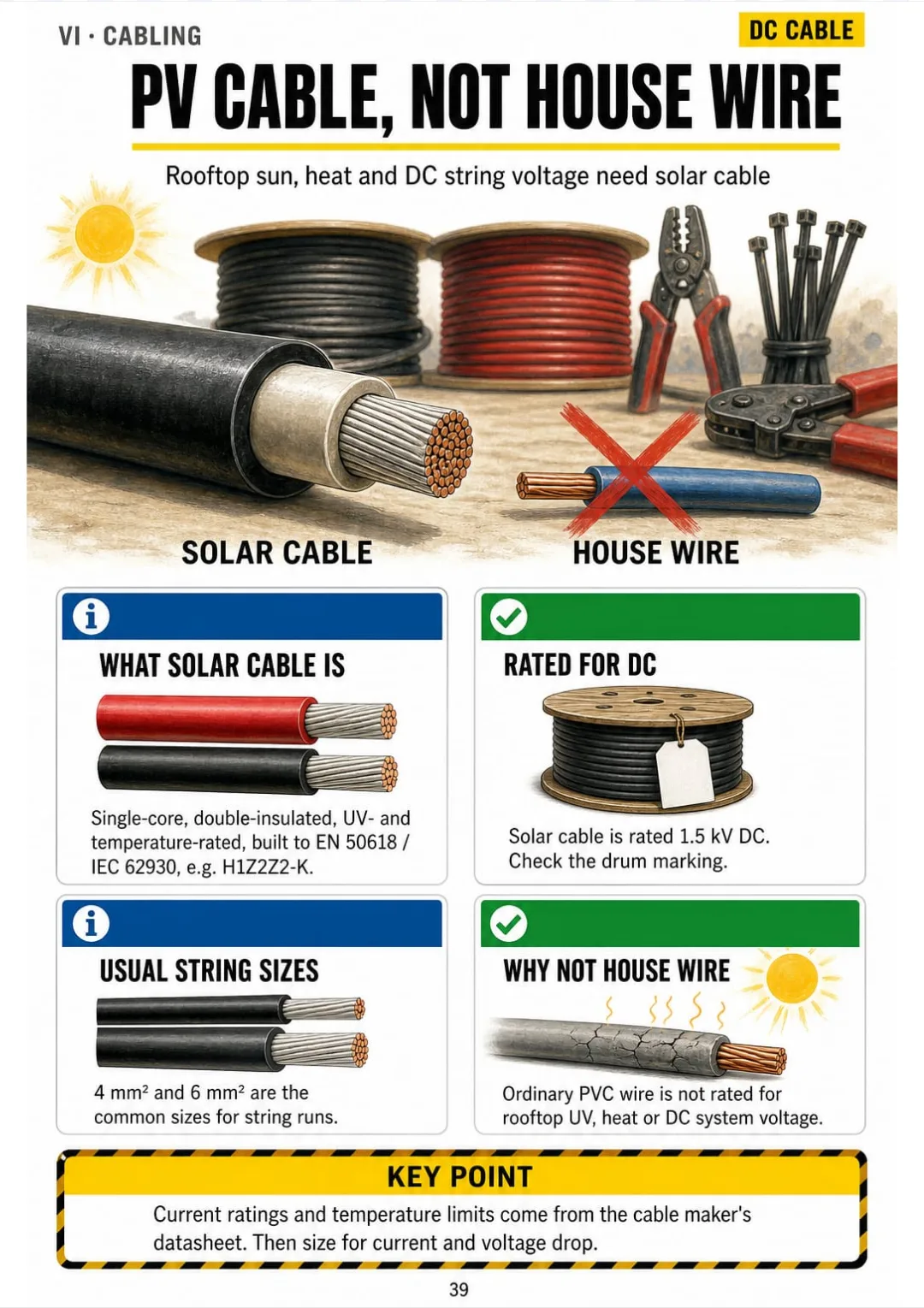
Solar string cable: double-insulated, UV-rated, 1.5 kV DC, usually 4 or 6 mm².
DC isolator: DC-rated, above cold Voc, a switch not fuses, next to the inverter
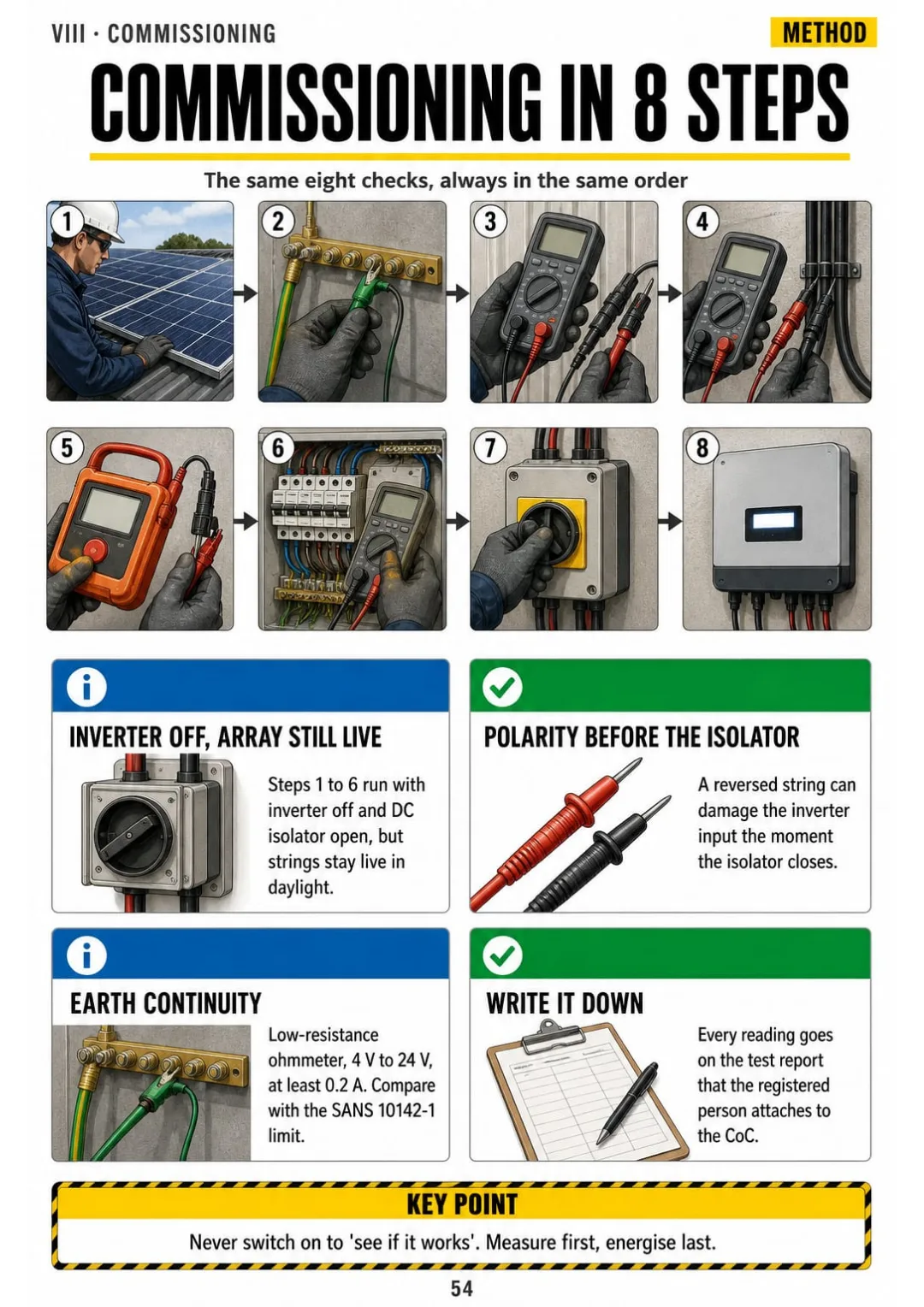
8 commissioning steps: visual → earth → polarity → Voc → insulation → AC → switch-on → function

Swipe to see more →

These are real pages from the book. The table of contents is the full one: 9 parts and 60 topics.

The Problem Isn't You. It's How It Was Explained to You.

You're on site with the panel datasheet and the inverter manual. The client wants to know how many panels, and you need to know how many fit in one string.

Your course notes give the temperature coefficient in one line. The formula is there, but not the order to work it, so you go by what the last installer did.

Fridge 150 W × 8 h = 1.2 kWh: the whole load list worked line by line.

In the book the string is one page: Voc from the datasheet, corrected for the coldest morning, times the number of panels, then the hot-roof Vmp check against the MPPT range. You see the order, so you can work it.

The same goes for peak sun hours, cold-morning Voc, battery depth of discharge, DC voltage drop and the commissioning sequence: each one has its own drawn page.

You write the list in front of the client, add up the kWh and move straight on to sizing, without opening your course notes again.

COMPARE FOR YOURSELF

The Same Topic, Two Ways to Study It

THIS
  • The manual: line after line of text
  • Site survey steps explained only in words
  • You arrive at the client's house unsure what to check first
Prior to the commencement of any design activity, the installer shall undertake a comprehensive assessment of the premises, which should include, but not necessarily be limited to, consultation with the client regarding energy requirements and expectations, the examination of historical electricity consumption records, an inspection of the existing distribution board and its condition, an evaluation of the roof structure, orientation and available area, the identification of shading obstructions throughout the year, the determination of suitable equipment locations and the planning of appropriate cable routes between all system components.
FOR THIS
  • The site survey drawn as 7 steps
  • The order in one box: client, bills, DB, roof, shading, location, cable routes
  • You see it and you know it
7 steps, always in order: client, bills, DB, roof, shading, location, cable routes
CONTENTS

Take a Look at the 9 Parts and 60 Topics

The system and the legal chain, site survey, sizing, string design, batteries, DC and AC cabling, protection and earthing, commissioning and handover, and a final review: 64 pages, all illustrated

IThe System and the Legal Chain · pp. 5-10
  1. From Panel to Plug: the Whole System in One Drawing
  2. Grid-Tied, Hybrid or Off-Grid
  3. DC Is Not AC: What Changes on the Array Side
  4. Who Does What: Installer, Registered Person, CoC
  5. SSEG Registration: Municipality or Eskom
  6. The Standards Map: Which Document Covers What
IISite Survey · pp. 11-16
  1. The Site Survey in 7 Steps
  2. Reading the Electricity Bill
  3. North-Facing: Orientation in the Southern Hemisphere
  4. Tilt Angle and Latitude
  5. Shading: One Shadow, a Whole String Down
  6. Roof Types and Fixings
IIISizing the System · pp. 17-23
  1. Load List: Watts × Hours = Wh
  2. Essential Loads vs Everything Else
  3. Peak Sun Hours: Not Daylight Hours
  4. Worked Example: How Many Panels
  5. Losses: Where the 20% Goes
  6. Sizing the Inverter: Continuous and Surge
  7. DC/AC Ratio: Array Bigger Than Inverter
IVString Design · pp. 24-31
  1. Reading the Panel Datasheet
  2. Series and Parallel: Volts Add, Amps Add
  3. Cold Morning Voc: the Number That Kills Inverters
  4. Maximum Panels per String
  5. Hot Roof Vmp: Staying Inside the MPPT Window
  6. Current Check: Isc and the MPPT Input
  7. Two MPPTs: When to Split the Array
  8. Worked Example: Full String Design
VBatteries · pp. 32-38
  1. Lithium Iron Phosphate vs Lead-Acid
  2. Depth of Discharge and Usable kWh
  3. Worked Example: Battery for Load Shedding
  4. The BMS and Inverter Communication
  5. Battery Cables, Fuse and Isolator
  6. Where to Put the Battery
  7. Charge Settings: Voltages and SOC Limits
VIDC and AC Cabling · pp. 39-45
  1. PV Cable: Why Not Ordinary House Wire
  2. DC Voltage Drop, Worked
  3. Connectors: Same Brand, Same Type
  4. Routing Cables on the Roof
  5. AC Side: Inverter to the DB
  6. Neutral and Earth in Backup Mode
  7. The Single-Line Diagram
VIIProtection and Earthing · pp. 46-53
  1. The Protection Chain in One Drawing
  2. String Fuses: When You Need Them
  3. DC Isolator: Rated for DC, Rated for the Voltage
  4. Surge Protection: DC and AC
  5. Earth Leakage and the Inverter
  6. Earthing the Array
  7. Earthing Systems: TN-C-S and TT
  8. Labels and Warning Signs
VIIICommissioning and Handover · pp. 54-59
  1. Commissioning in 8 Steps
  2. Measuring String Voc and Isc
  3. Insulation Resistance on the DC Side
  4. Switch-On and Switch-Off Sequence
  5. Testing Backup and Anti-Islanding
  6. Handover to the Client
IXReview: Mistakes and Checklists · pp. 60-64
  1. Five Calculation Mistakes
  2. Five Wiring and Protection Mistakes
  3. Why the Inverter Trips: First Checks
  4. The Whole Installation on One Page
  5. Formula Sheet

One Page, One Topic, All Clear

Think of it this way:

It's a winter morning on a Highveld roof and you're about to connect a string of twelve panels to the inverter. You need to know the string stays under the inverter's maximum DC voltage on the coldest sunrise of the year, below zero.

You open the cold-morning Voc page and see the panel's Voc, the temperature coefficient and the correction worked out step by step, with the inverter's limit drawn as a line you don't cross.

LiFePO4: 16 × 3.2 V = 51.2 V, 80-90 % usable · Lead-acid: 24 × 2 V = 48 V, about 50 %

The same with the panel datasheet, LiFePO4 versus lead-acid, PV cable, the DC isolator and the 8 commissioning steps: each one on its own page.

Solar PV Installer Illustrated is 9 parts and 60 topics, all drawn, and it ends with the most common mistakes, the whole installation on one page and a formula sheet.

What you see drawn, you don't have to memorize.

What's Inside Solar PV Installer Illustrated:

Ipp. 5-10

The System and the Legal Chain

The whole system from panel to plug, grid-tied, hybrid or off-grid, what changes on the DC side, who signs the CoC, SSEG registration and which standard covers what.

IIpp. 11-16

Site Survey

The site survey in 7 steps, reading the electricity bill, north-facing orientation, tilt and latitude, shading and roof fixings.

IIIpp. 17-23

Sizing the System

The load list in Wh, essential loads, peak sun hours, how many panels, where the losses go, inverter sizing and the DC/AC ratio.

IVpp. 24-31

String Design

The panel datasheet, series and parallel, cold-morning Voc, maximum panels per string, hot-roof Vmp, the current check, two MPPTs and a full worked string.

Vpp. 32-38

Batteries

LiFePO4 versus lead-acid, depth of discharge, a battery sized for load shedding, the BMS, battery cables and fuse, where to put it and charge settings.

VIpp. 39-45

DC and AC Cabling

PV cable, DC voltage drop worked out, connectors, roof cable routes, inverter to DB, neutral and earth in backup mode and the single-line diagram.

VIIpp. 46-53

Protection and Earthing

The protection chain, string fuses, the DC isolator, surge protection, earth leakage, earthing the array, TN-C-S and TT, and labels.

VIIIpp. 54-59

Commissioning and Handover

Commissioning in 8 steps, string Voc and Isc, insulation resistance, the switch-on and switch-off sequence, backup and anti-islanding tests, and client handover.

IXpp. 60-64

Review: Mistakes and Checklists

Five calculation mistakes, five wiring mistakes, why the inverter trips, the whole installation on one page and a formula sheet.

At the end of the book: Five calculation mistakes, five wiring mistakes, first checks when the inverter trips, the whole installation on one page and a formula sheet.
Plus: 2 Free Books

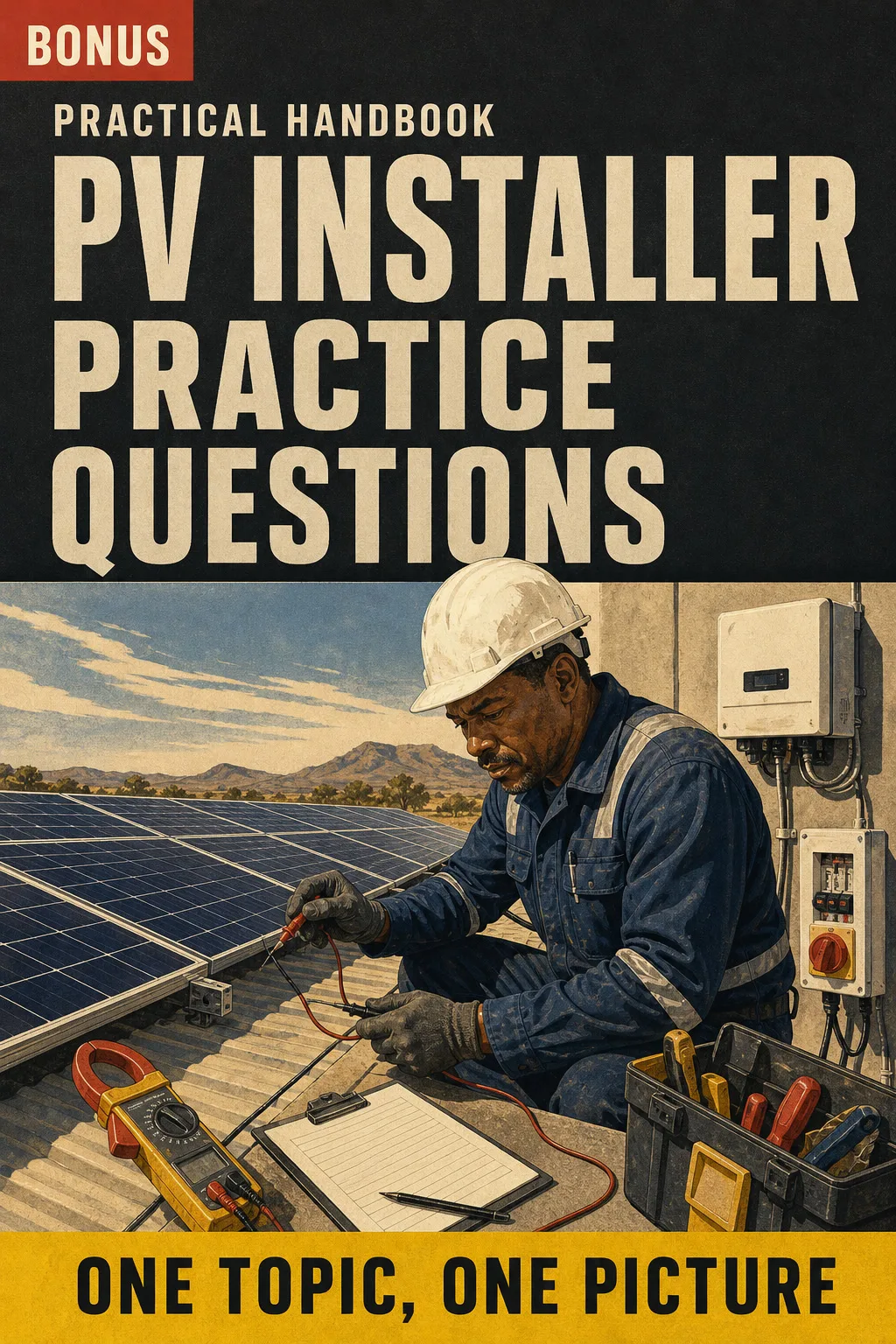
PV Installer Practice Questions

BONUS 1: «PV Installer Practice Questions»

Value on its own: US$ 17.90

Exam-style questions with worked answers on sizing, strings, protection and testing, so you can check what you really know before the written and practical assessment.

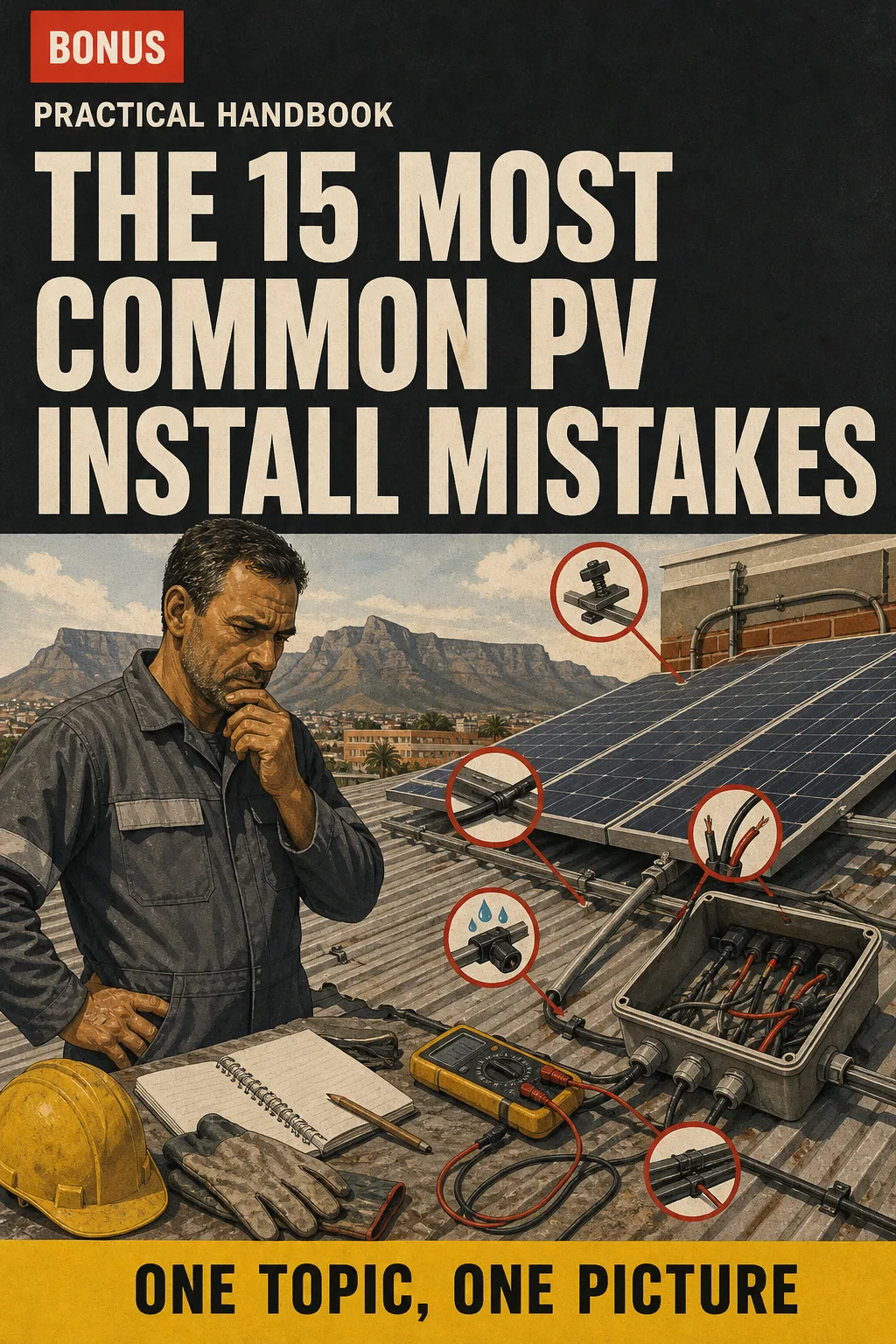
The 15 Most Common PV Install Mistakes

BONUS 2: «The 15 Most Common PV Install Mistakes»

Value on its own: US$ 14.90

Each frequent mistake drawn before and after (wrong string voltage, missing DC isolator, poor earthing, bad roof fixings), so you spot it on site before it becomes a callback.

Solar PV Installer Illustrated with 2 Free Books

  • Solar PV Installer Illustrated: 64 illustrated pagesUS$ 63
  • BONUS 1: PV Installer Practice QuestionsUS$ 17.90
  • BONUS 2: The 15 Most Common PV Install MistakesUS$ 14.90
  • High-resolution PDF to printIncluded
Total value US$ 95.80
YOUR PRICE:
US$ 27
You save US$ 68.80
YES, I WANT SOLAR PV INSTALLER ILLUSTRATED FOR US$ 27

📄 This is a digital PDF book sent to your email: nothing is printed or shipped.

Secure purchaseEncrypted payment30-day guarantee

PDF by email: We email you Solar PV Installer Illustrated as a PDF, together with the two free books. It's a single payment: no installments, no extra charges.

Who This Book Is For

You're doing the solar PV course

You're doing the solar PV course

Every calculation from the course sits on its own drawn page, worked with real numbers, so you can follow it again at home.

Your PV GreenCard assessment is coming up

Your PV GreenCard assessment is coming up

You review sizing, strings, protection and testing in the same order every time, and check yourself with the practice questions.

You already work as an electrician

You already work as an electrician

You skip what you know from AC and go straight to what changes on the DC side: strings, isolators, batteries and earthing.

Everything You Get Today

US$ 95.80US$ 27
YES, I WANT SOLAR PV INSTALLER ILLUSTRATED FOR US$ 27

📄 This is a digital PDF book sent to your email: nothing is printed or shipped.

30DAYS
GUARANTEE

30-Day Guarantee

Try Solar PV Installer Illustrated for 30 days, bonus books included.

We refund everything if the file won't open, if the book isn't what you see here, if you were charged twice or if the email doesn't arrive. Just email us.

You pay once. No subscriptions.

Frequently Asked Questions

Is it for me if I'm already a registered electrician?

Yes. It doesn't explain what a volt is: it starts with what changes on the DC side and works through strings, batteries, protection, earthing and commissioning.

Where does the content come from?

It's written against the current versions of SANS 10142-1, SANS 10142-1-2, NRS 097-2-1 and the Electrical Installation Regulations under the Occupational Health and Safety Act 85 of 1993. Metric units, South African context.

Is it official material?

No. It's independent study material, not affiliated with or endorsed by SAPVIA, the PV GreenCard scheme, the SABS, the Department of Employment and Labour or Eskom.

Does it replace the course or the training?

No. It's for studying and reviewing alongside your training and site experience. It doesn't replace an accredited course or the registered person who issues the CoC.

Does it cover the PV GreenCard assessment? Do I get a certificate?

It covers the topics you work through for the written and practical assessment: sizing, strings, batteries, protection, earthing and commissioning in order. The practice questions are written for this book, not taken from any assessment. It gives no certificate or GreenCard: that only comes from an accredited course and assessment.

How do I get it?

As a PDF by email, to the address you enter at checkout. The 2 bonus books are PDFs too.

Do I have to pay every month?

No. It's a one-off payment.

Can I have it on paper?

Yes. Print the PDF at home or at a print shop and take it to site.

How does the refund work?

You have 30 days. We refund everything if the file won't open, if the book isn't what you see on this page, if you were charged twice or if the email doesn't arrive: just email us.

Before You Close This Page

No more rereading notes that don't stick.

Cold-morning Voc: you see it drawn and that's it.

You get to the assessment and the job knowing where everything is.

Drawings make studying faster.

The book is right below.

One-time payment: US$ 27 · Guarantee: 30 days · PDF by email

YES, I WANT SOLAR PV INSTALLER ILLUSTRATED FOR US$ 27

📄 This is a digital PDF book sent to your email: nothing is printed or shipped.